12 September 2026
Export Grade Spices: What ETO, Residue Limits and Lab Tests Mean
"Export grade" is printed on a lot of spice packs in India, and in 2024 it became a phrase many families started searching for. When food regulators in Hong Kong and Singapore pulled some Indian spice mixes off their shelves over ethylene oxide, home cooks asked a fair question: what do export grade spices actually mean, and should it matter for my own kitchen? This guide explains it in plain words, from ETO and pesticide residue limits to lab reports, and ends with a simple checklist you can use the next time you buy elaichi, kali mirch or laung.
What export grade spices mean, and what they do not
There is no single government stamp in India called "export grade". The phrase is trade shorthand. It usually means a spice that can meet the rules of the country it is being shipped to. Those rules cover three broad areas:
- Physical quality: size, colour, moisture, broken pieces, stems, dust, and foreign matter such as stones or insect parts.
- Chemical safety: pesticide residues, fumigants such as ethylene oxide, aflatoxins (toxins made by moulds), and illegal dyes such as Sudan red.
- Microbial safety: bacteria such as Salmonella, a known concern in dried spices all over the world.
Different buyers set the bar at different heights. The European Union is known for some of the strictest pesticide limits anywhere. The United States pays close attention to Salmonella and filth. Gulf markets have their own standards too. So when a seller says "export grade", the honest follow-up question is: export grade for where, and checked how?
ETO in spices: why ethylene oxide made the news
Ethylene oxide, often shortened to ETO or EtO, is a gas that has been used in some parts of the world to kill microbes in dry foods. It works, but it can leave residues, and the International Agency for Research on Cancer classifies it as a Group 1 carcinogen. That is why many countries either ban its use on food or allow only tiny traces. As reported by Business Standard, the EU limit for ethylene oxide is 0.1 mg per kg.
In April 2024, food regulators in Hong Kong and Singapore reported ethylene oxide in a few spice mix products from two well known Indian brands, and recalls followed. Other regulators then took a closer look at Indian spices. Around the same time, Business Standard reported that EU authorities had flagged ethylene oxide in 527 food products linked to India between September 2020 and April 2024, based on data from the EU's Rapid Alert System for Food and Feed (RASFF). That list covered many kinds of food, not only spices.
India responded quickly. From May 2024, the Spices Board made ETO testing mandatory for spice consignments going to Singapore and Hong Kong, as Business Today reported. The Board also issued guidelines asking exporters not to use ETO at any stage of the supply chain, and to use alternatives such as steam sterilisation that FSSAI permits. FSSAI, in turn, ordered wider sampling of spice brands sold within India.
Why this matters to a home cook
The recalls were about a few specific products, mostly blended masalas, not about every Indian spice. But the episode showed something useful. A spice can look perfect and smell wonderful and still carry a residue that only a laboratory can find. Your nose can tell you about freshness. It cannot tell you about ETO.
Pesticide residue limits (MRLs), explained simply
Every pesticide allowed on a crop has a maximum residue limit, or MRL. It is the highest amount of that chemical legally allowed to remain on the food, usually measured in milligrams per kilogram. In India, FSSAI sets these limits. The EU, the US and other markets set their own, and they do not always match. A lot of pepper or cardamom that is within Indian limits can still fail an EU limit for one particular chemical, simply because that chemical is not approved in Europe.
This is why export shipments are commonly tested against the destination's list before they leave. Laboratories use instruments such as gas and liquid chromatography with mass spectrometry to screen for hundreds of residues in one run. For a buyer, the practical point is simple: a lab result only means something if you know which limits it was checked against.
What a spice lab report usually checks
If you ever ask a supplier for a certificate of analysis, these are the lines worth looking for:
- Moisture: too much invites mould.
- Volatile oil: the aroma compounds. For cardamom, clove and pepper, higher is usually better.
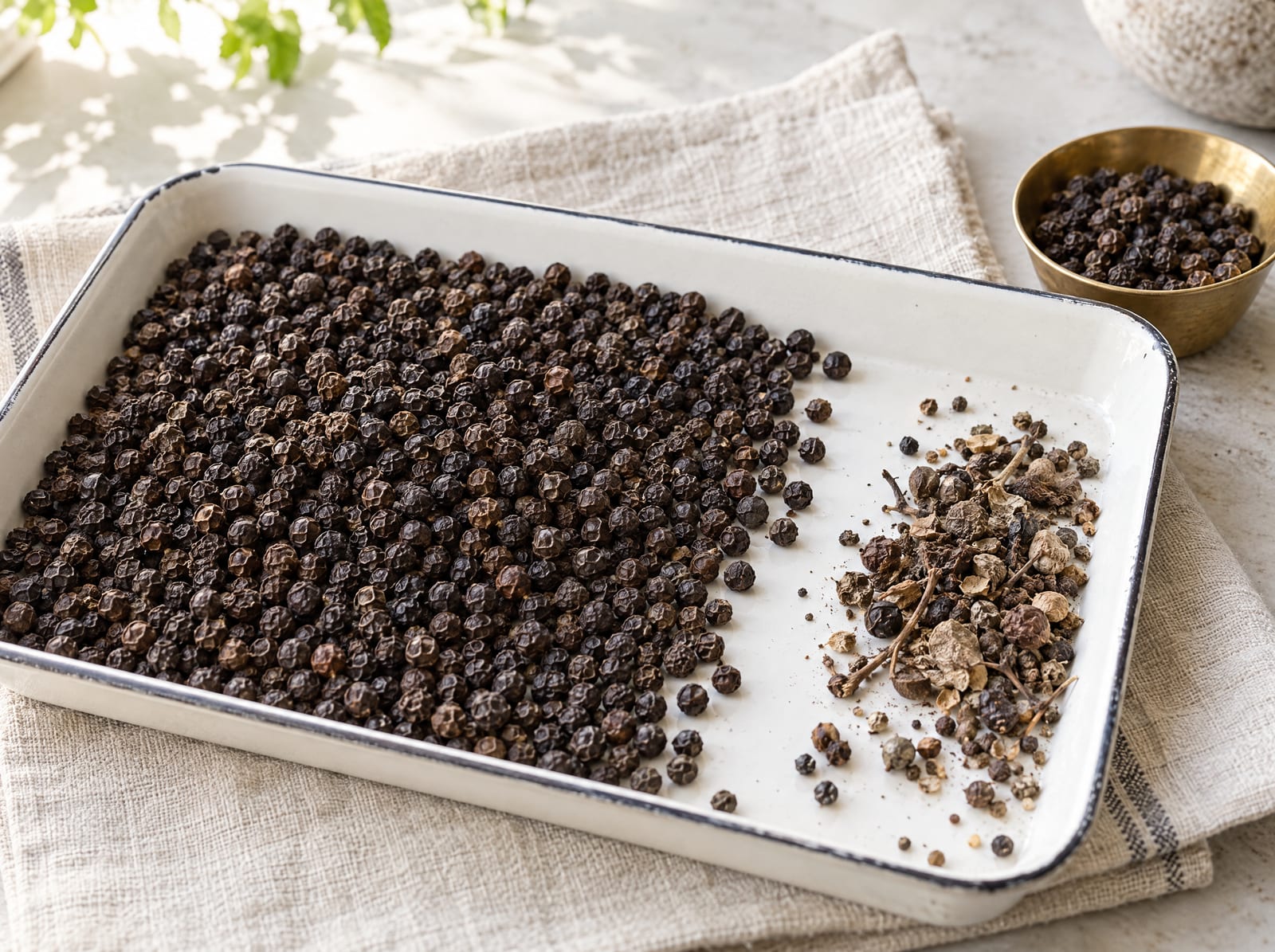
- Extraneous matter: stems, dust, stones and other bits that should not be there.
- Pesticide residues: screened against a named standard, such as FSSAI or EU limits.
- Ethylene oxide and 2-chloroethanol: ETO and its breakdown product are often reported together.
- Aflatoxins and Sudan dyes: most relevant to chilli, turmeric and ground blends.
- Microbiology: Salmonella, E. coli, and yeast and mould counts.
A good report names the laboratory, the batch or lot number, the date and the test method. In India, laboratories accredited by NABL are the usual reference point.
Why EU and US rejections keep making headlines
India is one of the world's biggest spice exporters, so even a small share of problem lots adds up to a long list of alerts. The reasons for rejection are fairly consistent. In Europe, pesticide residues and ETO lead the list. In the US, the FDA's risk profile on pathogens and filth in spices found that imported spice shipments sampled between 2007 and 2009 had an average Salmonella prevalence of about 6.6 percent. Filth, meaning insect fragments, hair and similar matter, was the other big issue.
These numbers are not a verdict on Indian spices as a whole. They reflect how dried spices are grown, dried and stored in many countries: often by small farms, sometimes on open ground, frequently in humid weather. The fix is better handling at every step, meaning clean drying, clean storage, careful grading, and testing before shipping.
How to judge spice quality as a home buyer: a checklist
You will not get a lab report with a 100 g pouch, and you do not need one for every purchase. But you can stack the odds in your favour.
- Look for the FSSAI licence number on the pack. It is the legal minimum for packaged food in India, and it tells you who is responsible for what is inside.
- Prefer whole spices. A whole pod, bud or peppercorn is much harder to adulterate than a powder, and you can see its size, colour and shape for yourself.
- Check the grading. Uniform size means someone took the trouble to sort. With cardamom, look for a stated pod size, such as 8 mm.
- Read the ingredient line. A single spice should list one ingredient. No added colour, and no anti-caking agent in whole spices.
- Trust your senses for freshness. Crush one peppercorn or scratch one clove. A strong, clean aroma means the volatile oils are still there.
- Check the packing. Resealable, airtight pouches keep aroma in and moisture out. Look for a packing date and a best before date.
- Look at who stands behind it. Certifications such as ISO 22000 (a food safety management standard) and registration with bodies like the Spices Board and APEDA show that a business works inside formal systems. They are not a lab test of your particular packet, but they are a good sign of process.
How GHI approaches it
GHI Foods is a certified exporter. The certifications we list are FSSAI, APEDA, ISO 22000 and the Spices Board of India, and we are US FDA registered. We grade our whole spices before packing (our whole green cardamom is hand-selected 8 mm pods), and we pack in short, frequent runs into resealable aroma-lock pouches. The same packs we sell at home go into our export containers. If you buy for a business and want specifications or samples, our export desk can help. For your own kitchen, the whole spices collection is a good place to start.
Frequently asked questions
Is "export quality" on a spice pack a certified claim?
No. It is a trade description, not a government certification. Look instead for an FSSAI licence number, a clear ingredient list and, if you buy in bulk, a recent lab report that names the limits the spice was tested against.
Can I test spices for ethylene oxide at home?
No. ETO residues cannot be seen, smelled or tasted, and they can only be measured in a laboratory. At home you can check freshness, aroma and some obvious adulteration, but not chemical residues.
Are whole spices safer than ground masalas?
Whole spices are easier to inspect and harder to adulterate, and the 2024 recalls mostly involved blended powders. That said, any spice can carry residues, so buy from a brand that is clear about who packs it and how.
Why are some Indian spice shipments rejected in Europe?
Most EU alerts relate to pesticide residues above EU limits, ethylene oxide, aflatoxins or microbial contamination. EU limits are often stricter than those in other markets, so a spice can be legal in one country and rejected in another.